Introduction
Certificate rigid boxes protect a product that looks sturdy but behaves like the most delicate item in this entire catalog once it's actually in transit — a flat sheet of paper or card stock has almost no structural resistance of its own, and a single bent corner or crease can turn an otherwise perfect diploma or certification into something that looks damaged the moment it's unboxed. Unlike most products in this catalog, a certificate genuinely can't be straightened back out once creased, which makes prevention the only real strategy available here.Protecting a Flat, Unforgiving Format
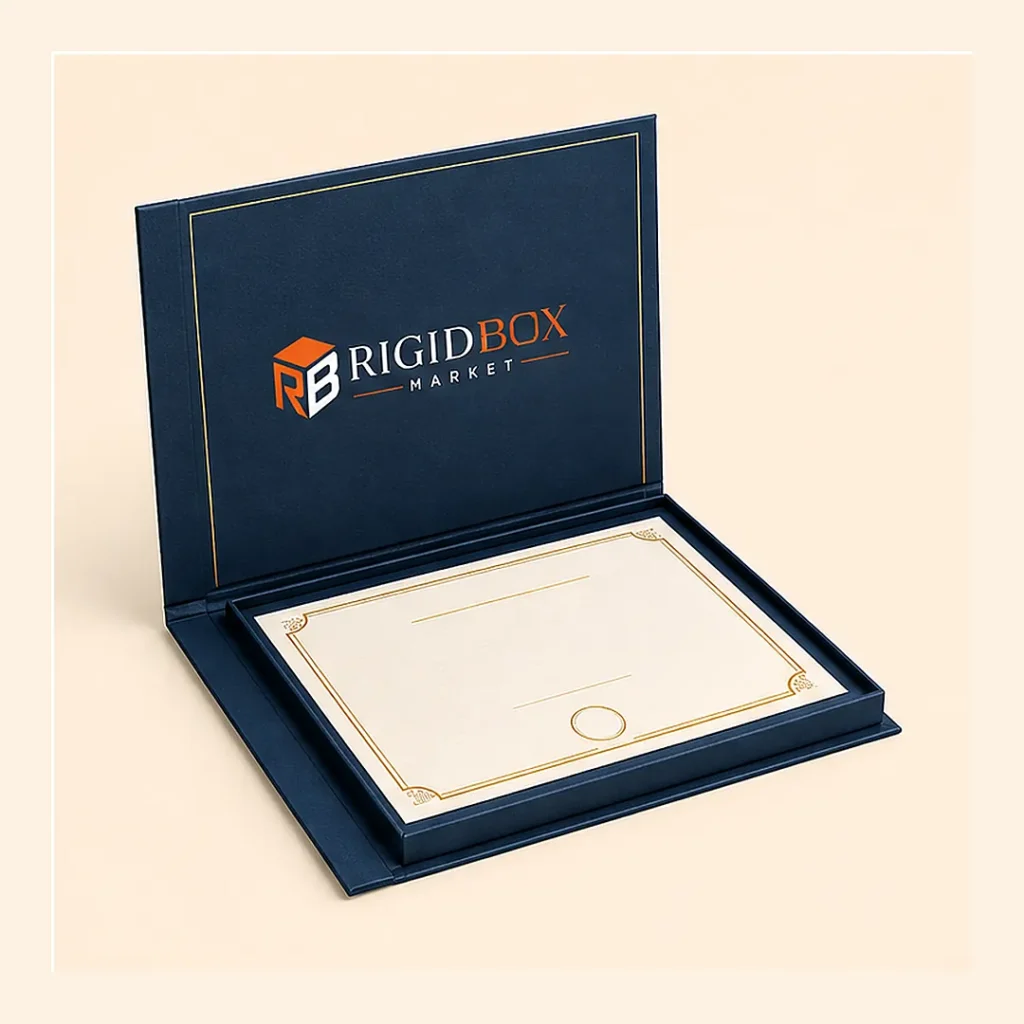
The shell uses rigid chipboard construction built as a flat, shallow box or portfolio-style case, sized closely to the certificate's dimensions, since the document itself needs the box to hold a precise flat shape throughout shipping rather than allowing any flex or compression. Multiple certificates or a certificate paired with a cover letter are typically layered on a flat interior platform, sometimes with a protective sleeve or tissue between pieces to prevent any embossed seal or foil detail from marking the surface beneath it. Raised wax or foil seals, common on formal certificates, need particular care in this layering, since a seal pressed against another document's surface during shipping can leave a visible impression. Because certificates are frequently produced for a specific graduation, certification, or award date, production quantities tend to match a fixed recipient list precisely, similar to invitation packaging elsewhere in this catalog. A certification body issuing credentials to a specific graduating cohort generally needs box quantities to match that exact recipient count rather than ordering a rounded, approximate volume.Customization Options
Box dimensions and interior layering can be built around a specific certificate size and any accompanying documents, and this format supports the full range of standard finishing — foil stamping, embossing, debossing, spot UV, and matte, gloss, or soft touch lamination. Standard certificate sizes are common enough that many institutions can work from an existing box specification rather than commissioning an entirely custom size. Institutions frequently match the box's exterior finish to their own seal or crest, foiled or embossed in the institution's specific color, for a presentation that echoes the certificate's own formal design language. That color-matching detail is often worth confirming precisely, since an institution's official color codes can be surprisingly exact and worth getting right for a formal credential.- Flat, precisely sized shell built for document protection
- Layered interior platforms with protective sleeves between pieces
- Foil stamping, embossing, debossing, and spot UV finishing
- Exterior finish coordinated with institutional seals or crests
- Matte, gloss, or soft touch lamination